
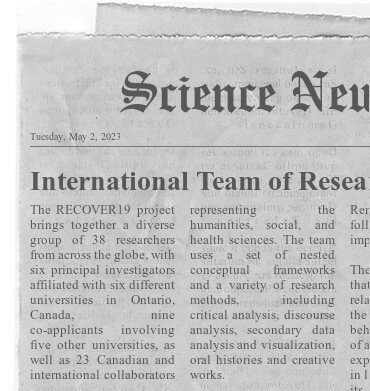
International team of researchers examines the role of transparency, shared responsibility, and evidence-informed decision-making in crisis management and post-pandemic recovery
The starting point for this research is the realization that we cannot recover from COVID-19 without impartially analyzing the pandemic response of the last three years. The project team plans to assess lockdowns, school closures, workplace vaccination policies, and other controversial public health measures through a critical social science lens; philosophical, ethical, historical, legal, medical, geopolitical, and other dimensions will also be explored.
This research project will contribute to understanding how local communities can be optimally engaged in decision-making during future emergencies to strengthen social cohesion and promote transparency, shared responsibility and evidence-informed decision-making. It will also focus on how governments can communicate honestly and effectively with citizens to build trust, forge consensus, and promote cooperation to achieve shared goals while respecting individual rights.
The research team aims to interrogate the global societal responses to COVID-19 in order to contribute to post-pandemic recovery and preparedness for future pandemics and other global crises. The specific objective of this research is to assist civil society institutions (government agencies, colleges and universities, professional associations) with the generation or collection, analysis and interpretation, as well as dissemination and integration of diverse and relevant evidence for informed decision-making that will promote resilient, inclusive communities.
The RECOVER19 project brings together a diverse group of 38 researchers from across the globe, with six principal investigators affiliated with six different universities in Ontario, Canada, nine co-applicants involving five other universities, as well as 23 Canadian and international collaborators representing the humanities, social, and health sciences. The team uses a set of nested conceptual frameworks and a variety of research methods, including critical analysis, discourse analysis, secondary data analysis and visualization, oral histories and creative works.
The New Frontiers in Research Fund (NFRF) – Special Call supports research that directly responds to the United Nations Research Roadmap for the COVID-19 Recovery in order to address global socio-economic inequities that have been heightened by the pandemic. It aims to foster a more equitable, sustainable, and resilient post-pandemic reality. Among the priorities outlined in the UN Roadmap, this project addresses the research pillars Social Cohesion and Community Resilience, Social Protection and Basic Services, and Health Systems and Services. It also contributes to four United Nations Sustainable Development Goals regarding healthy living and quality education for all, resilient and inclusive communities, access to justice, and accountable institutions.
Next week, we will write about the five case studies included in our planned research.
 RECOVER19