
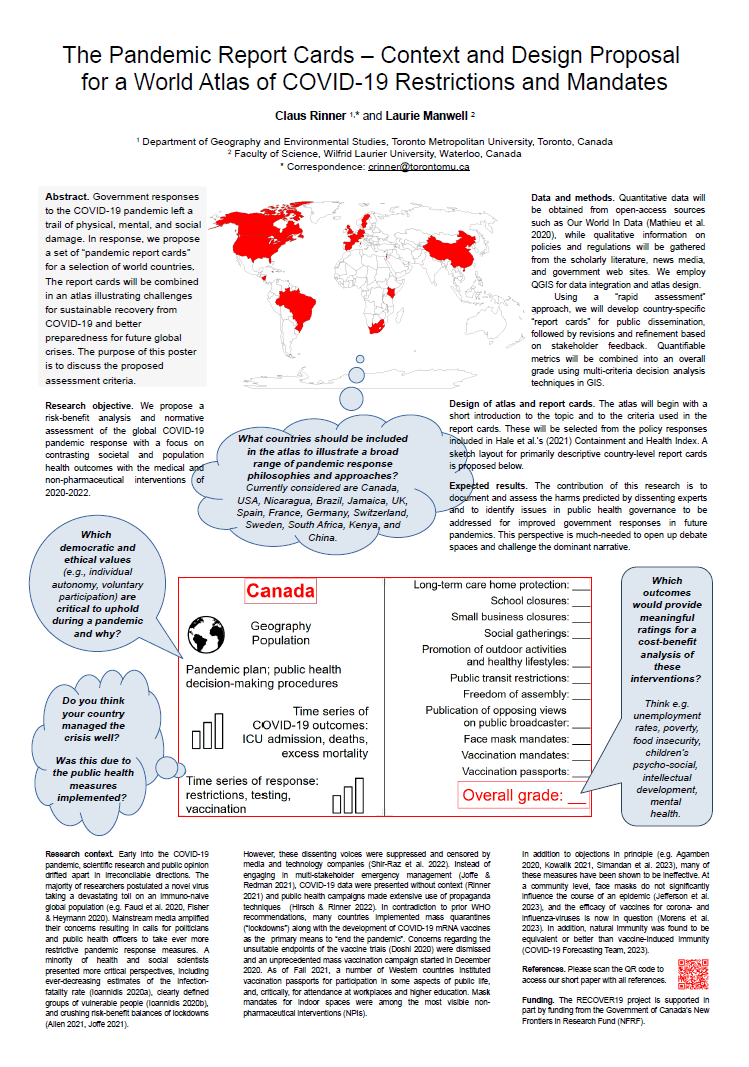
At this week’s conference of the Association of Geographic Information Laboratories in Europe in Delft, Netherlands, Dr. Claus Rinner presented a poster titled “The Pandemic Report Cards – Context and Design Proposal for a World Atlas of COVID-19 Restrictions and Mandates”. The poster and associated two-page paper signal a starting point for the RECOVER19 grant’s case study 1 and were co-authored by Dr. Laurie Manwell.
The one-minute poster pitch at the conference went as follows:
In this research, we conduct both a normative assessment and a risk-benefit analysis of the global pandemic response to COVID-19. We take a highly critical view based on established ethical, democratic, and medical norms, and interrogate the need, safety, and efficacy of the public health measures. This is a case study within the international RECOVER19 collaboration for sustainable post-pandemic recovery. On the poster, we present a first set of criteria and the design for an atlas consisting of country-level “pandemic report cards”, which I look forward to discussing with you.
The short paper gives examples from the scientific literature that cast serious doubts on the narratives of a devastating pandemic threat and an effective public health response. It deplores the suppression of dissenting experts and argues the need for a thorough, critical (re)assessment of the COVID-19 pandemic response. The PDF version of the paper can be accessed by clicking on the following image.

The poster was based primarily on the text of the short paper. It also includes some additional items for discussion at the conference, which centered on questions of the feasibility of this research and the quantifiability of pandemic response measures and their effects. The full-size version of the poster can be accessed by clicking on the following thumbnail image.

The authors wish to acknowledge the RECOVER19 collaboration and Dr. Mariko Uda for feedback and suggestions on the poster.
 RECOVER19