
Note: This manuscript has now been published in the peer-reviewed International Journal of Environmental Research and Public Health.
As a side project of the COVID-19 country report cards and atlas research mentioned in an earlier post, our small team completed an article that attempts to quantify the discrimination experienced by unvaccinated citizens around the globe. Our index is based on the differentiated public health measures applied to vaccinated vs unvaccinated populations.
We used data from the Oxford COVID-19 Government Response Tracker (OxCGRT), which distinguishes restrictions on a daily basis by country for several bundles of restrictions. We took their Containment and Health Index and simply subtracted the values representing policies applicable to vaccinated individuals from those for unvaccinated, where those were higher (meaning tighter restrictions).
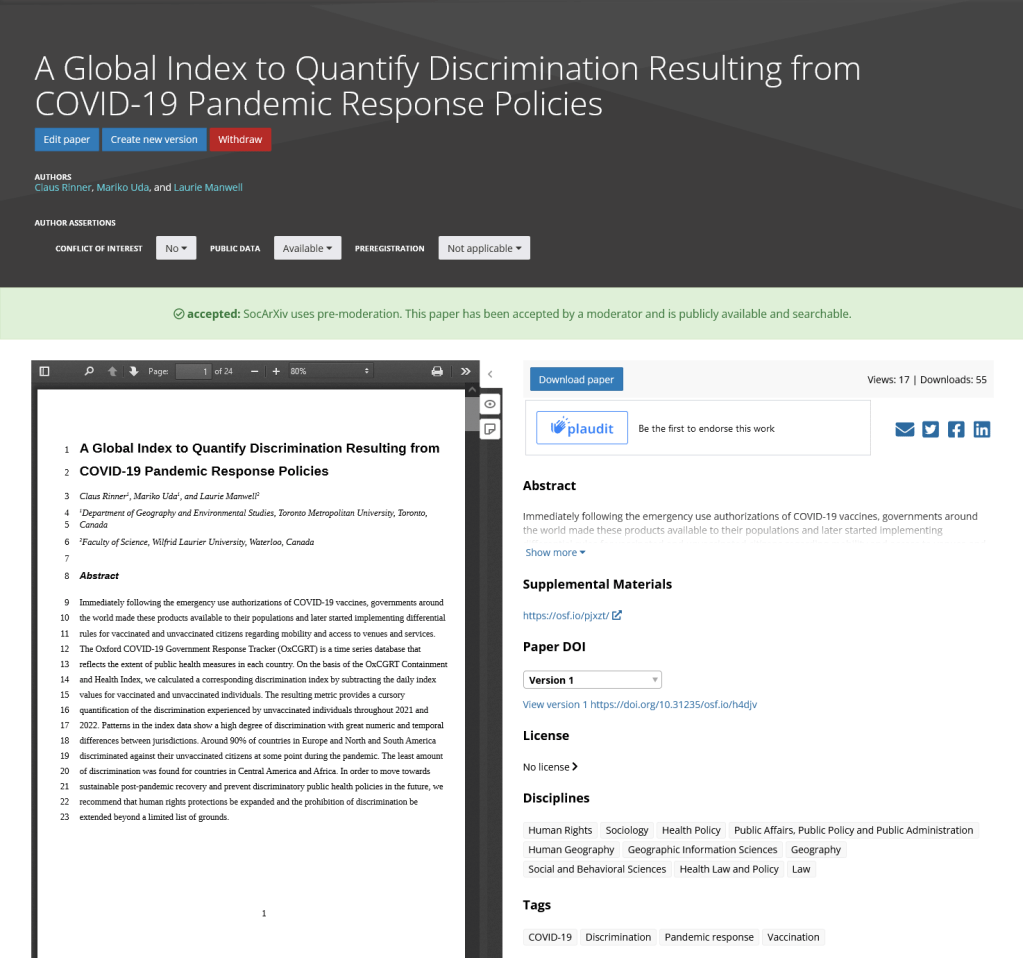
The 6,300-word paper is published as a preprint on the SocArXiv server linked to the Open Science Framework (OSF, not to be confused with the Open Society Foundation!). It is also currently under review with an international scholarly journal.
In terms of results, we describe interesting and concerning patterns of discrimination around the globe. Unsurprisingly, the Western countries implemented some of the most discriminatory policies, although not exactly “in lockstep”, in contrast to popular perceptions.
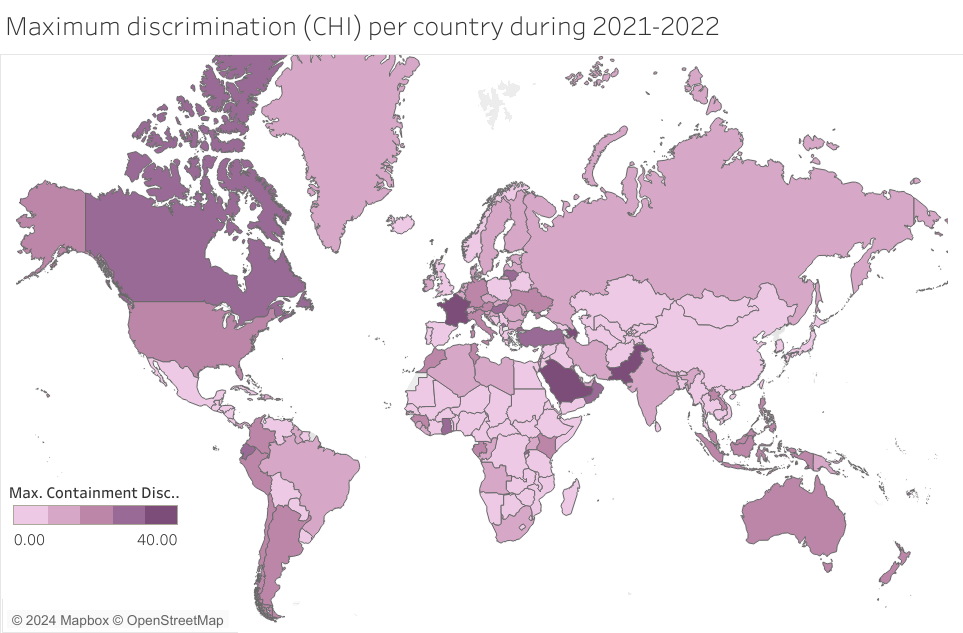
As an example from the preprint, the map above shows the worst offenders in terms of the highest index value reached at any point in the pandemic. The highest values in this measure did not always coincide with prolonged periods of discrimination, but it is difficult to defend either outcome.
We also discuss whether “discrimination” is the correct term to use, which we affirm based on its literal meaning and the serious impacts experienced by unvaccinated individuals. In this context, it may be worthwhile pointing out philosopher Michael Kowalik’s argument that “being unvaccinated is fundamentally not a choice.” We hope that our article will contribute to making it harder to implement discriminatory responses in future emergencies.
 RECOVER19